
Prove the person
Fingerprint or face verification at the front desk, matched against the enrolled member register.
- Sub-second one-to-one matching
- Liveness and anti-spoofing checks
- Offline capture with deferred sync
Each stage inherits verified data from the stage before it. The integrity of the final payment depends on the integrity of every step that preceded it. That is why the features are presented in the order they operate, not in order of importance.
From the moment a member presents to the moment a provider is settled, MedicalBytes keeps every record, rule and receipt in one place, and every decision inherits verified data from the step before it.
Fingerprint or face verification at the front desk, matched against the enrolled member register.
Cover, clinical appropriateness and affordability settled up front, automatically where the rules allow.
Paper, PDF, photograph or electronic feed converted into clean, coded, validated structured data.
The full rulebook applied per line, then a reconciled payment run with approval ceilings enforced.
The sequence matters. The architecture is deliberately linear: each stage inherits verified data from the stage before it, and the integrity of the final payment depends on the integrity of every step that preceded it. Tap a feature to open it.
Permissions attach to roles, not people. A user inherits exactly the rights of the roles held, scoped to the schemes, clients, branches and providers they may act on, for screen visibility and transaction authority alike.
Business value · protects clinical and financial data, blocks internal collusion, and gives audit examinable evidence.
One source of truth for who you pay and who pays you. Providers with their credentials, tiers and contracted tariffs on one side; corporate clients, brokers and schemes on the other.
Business value · no payment on a stale tariff, and no payment to a suspended or expired provider.
The full lifecycle of policies, schemes and members: quotation, onboarding, endorsements, renewals and termination. Smart onboarding compresses enrolment from weeks of manual keying into hours of supervised automation.
Business value · no claim is ever paid for an ineligible, suspended or terminated member.
Card-and-signature verification replaced by physiological proof. Fingerprint is the primary modality; facial recognition is the fallback for infants, the elderly, manual labourers with degraded ridges and cases where the hands are unavailable.
Business value · ends card sharing and impersonation, and makes phantom billing immediately visible.
The digital expression of what each plan covers, to what extent, at which providers and subject to which conditions, with a runtime that answers "how much is left" in real time rather than in a monthly reconciliation cycle.
Business value · over-limit spend is stopped at the desk instead of absorbed as a loss after payment.
The one moment where cost and appropriateness can still be influenced before liability is incurred. A request arrives, entitlement is proved against the live balance, and a decision is issued with an amount and a validity window attached to it.
Business value · nothing is committed before it is known to be covered, affordable and clinically appropriate.
Most requests are routine and protocol-compliant, and making a provider wait for a human to say so costs them time and costs you money. The engine settles those in seconds against your own rules, and reserves clinical judgement for the complex and the costly.
Business value · the clean majority clears without a desk, and the cases that need a clinician actually reach one.
Invoice capture is normally the largest labour cost and the largest error source in a claims operation. OCR, machine learning and natural language processing ingest invoices however they arrive and code them before they are allowed into adjudication.
Business value · no manual keying, no transcription risk, and only genuinely ambiguous documents reach a person.
The entire rulebook applied to every claim line: entitlement, tariff, authorisation, clinical consistency and benefit balance. What is properly due is paid, what is not is declined with a reason, and the whole book is continuously audited for error, abuse and fraud.
Business value · one answer per claim line, defensible variance, and the same rulebook applied every time.
The authoritative coding layer against which every diagnosis, service and price is validated, so that clinical intent, billed activity and contracted tariff always speak the same language.
Business value · removes the coding ambiguity that most provider disputes are actually made of.
Adjudicated claims turned into accurate, on-time, fully reconciled payments, with the right approvals, the right ceilings and segregation of duties enforced by the platform rather than by convention.
Business value · providers are paid predictably, and every cent paid reconciles to an adjudicated line.
The data generated by every other feature turned into live operational control and strategic insight, per stakeholder, per scheme and per provider, closing the loop back into product design, pricing and network management.
Business value · the risk becomes visible while there is still time to price it.
Features 1 and 2 are foundational reference layers · 3 to 7 govern entitlement and prospective control · 8 to 11 govern processing and settlement · 12 closes the loop.
Click through the five control points the platform applies to a single encounter. Every step inherits what the step before it verified. That is exactly why the last number can be trusted.
The encounter
Illustrative walkthrough using sample data.
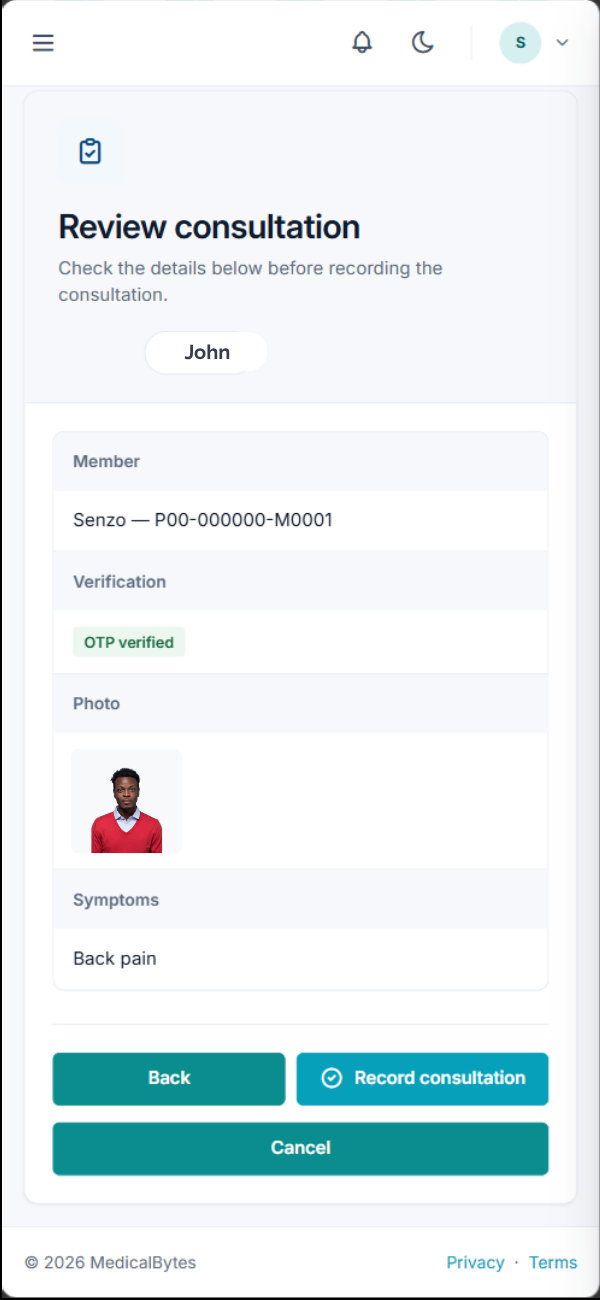
The member places a finger on the reader at reception. The template is matched one-to-one against the enrolled record, liveness is checked, and the encounter is stamped with member, facility and time before anything clinical happens.
The consumption engine resolves membership, dependant status, waiting periods and exclusions, then returns the live balance for every benefit the encounter could touch, including funds already reserved by another facility.
The requested services are checked against the benefit table, the tariff, the clinical protocol and the balance. Routine, protocol-compliant requests auto-approve; funds are reserved for the approved amount and validity window.
The provider submits a PDF. OCR and the coding engine extract every line, map free-text descriptions to ICD-10 and CPT, price each line against the contracted tariff in force on the date of service, and match the invoice to the authorisation and the verified encounter.
The rulebook runs on every line. Three lines pass straight through; the over-tariff line is repriced with a reason code the provider can see. The result enters the next payment run, where approval ceilings and segregation of duties are enforced by the platform.
Point-of-service app
Bring a sample of real claims and we will show you what the engine does with them, line by line.
Three engines do the work that normally consumes a claims floor, and each one hands the next one data it has already validated.
Invoices and clinical documents in any format (paper, PDF, photograph or electronic feed) read into clean structured data. No manual keying, no transcription risk.
Authoritative clinical coding, so the diagnosis, the billed activity and the contracted tariff always speak the same language.
Adjudicated claims turned into accurate, reconciled payments, with approval ceilings and segregation of duties enforced by the platform.
Tariff sets, scheme rules and provider contract terms are loaded per client, so the engine adjudicates against your rulebook rather than a generic one.
Give us a set of real claims and we will run them through the engine line by line: identity, entitlement, authorisation, coding, adjudication and settlement.
Tell us what you want to see and we will reply within one business day.